A note on the date: This essay was published on November 23, 2024.
On June 11th, 2020, OpenAI released its first commercial product to the public, GPT-3. Up until that point, OpenAI had remained strictly in-house, only releasing its research and very rarely lending its software to other tech giants. When they were first founded, they pledged to serve as a non-profit research company in order “to advance digital intelligence in the way that is most likely to benefit humanity as a whole, unconstrained by a need to generate financial return.”
Since then, OpenAI has grown quickly and entered the same competitive field as Google, Microsoft, and Facebook. The pace of change has made the company's promises harder to separate from its business decisions, which is part of why the technology deserves scrutiny instead of automatic awe.
The idea of artificial intelligence is something that is both exciting and terrifying. It is the replication of the human mind; the pinnacle of automation or even technology itself. The purpose of technology is to find easier, efficient, and effective ways to better perform the tasks that we do. Technological innovation has and will continue to change the way that we humans operate and perform tasks.
With every new technology, there is always a transition period. When the improved steam engine was patented in 1776 by James Watt, so came the Industrial Revolution. By being able to supply power efficiently, it led to the building of factories and the transition from hand-made production to automated machines.
This led to unprecedented economic growth, most notably in textile manufacturing, responsible for knitting fabrics used for clothing, furnishing, bedding. While before you required a number of skilled workers who were experienced and capable enough to use a loom, now you needed only one person with a lace machine that could produce the same work as many without requiring much skill. With this, production soared, especially with more and more material being readily accessible, such as with the invention of the cotton gin in 1794 by Eli Whitney.
However, this economic prosperity was not given to every person. On December 15, 1811, the London Statesman issued a warning stating that 20,000 textile workers had lost their jobs due to automated machinery. Soon, protests erupted across London, with workers breaking into factories and smashing lace machines apart. “Nine Hundred Lace Frames had been broken”, the newspaper reported.
They called themselves the Luddites. Soon, the picture of the man, holding a sledgehammer, ready to strike down against the machines struck the minds of manufacturers and factory owners.
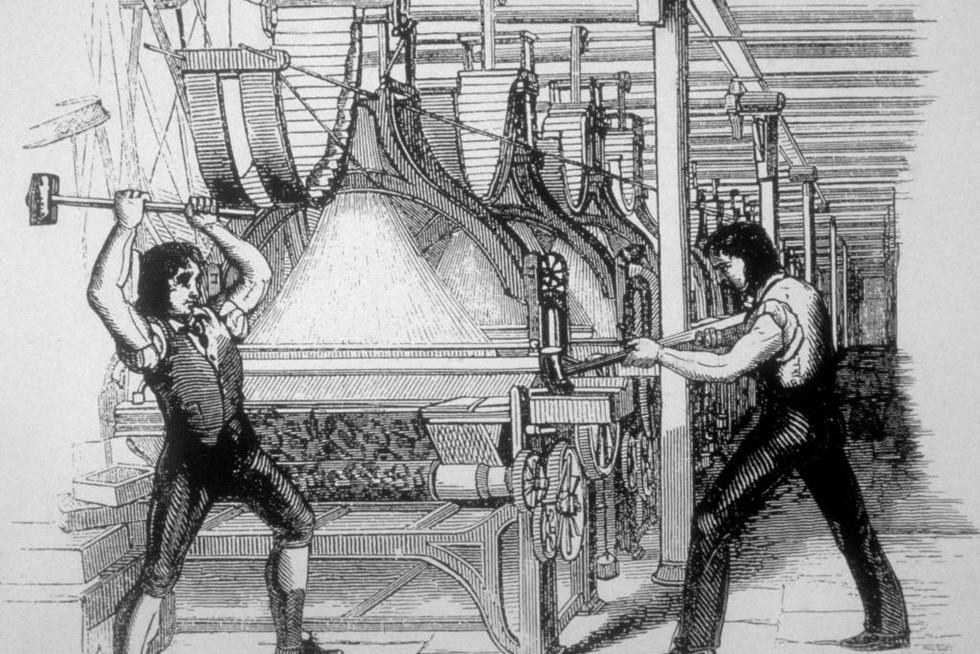
Throughout the nineteenth century, they would continue their raids and protests in an effort to bring about economic reform. You could say that they were one of the very first worker unions, fighting for equity such as increased minimum wages and the elimination of child labor in order to obtain fair employment. However, their riots brought little success, as they were met with decisive military force, often leading to the execution or deportation of these Luddites.
Nowadays, the term Luddite is used in a derogatory way to refer to someone who is opposed to new technologies. However, this is misleading. The Luddites were never against technology, in fact, they did use technology beforehand, with the invention of the loom. However, they were against the use of technology that led to the mass unemployment and displacement of people.
But, how much does this precedent hold up today? It's been quite a bit since the 19th century, and we have changed ever so much. With the invention of the modern computer, technology has been democratized across the globe. We live in an interconnected world where the entire library of information lays at our fingertips. If we have a question, we can search it up and read through trillions of results to find an answer. If we need to communicate, we have plenty of different means that we can choose from.
Production and manufacturing is at an all-time high. There are entire factories that have few, if not no workers at all, completely automated by robotic arms and machines. Automobiles, planes, and cargo allow for the mass distribution of these products across the entire globe. Practically everything that we do involves a computer in one way or another: our money is stored in banks, shopping can be done on the web without even having to leave your room, and this document is readily accessible thanks to your computer and the cloud.
No longer does the individual have to worry if they will have enough food to survive. No longer does the individual have to worry if they will be able to contact friends and family. Hell, no longer does the individual have to worry about whether they need to buy groceries today.
At the very fundamental level, technology is merely just a tool. But these tools, especially when democratized to the hands of everyone, can be used for good and evil. There is absolutely no doubt that technology has led to the life that we have today, an immense improvement in the quality of life thanks to solving the problems that were prevalent in times before.
But, these technologies can restrict and oppress people. Let's use the Internet as an example. It's like a wild west, and has provided a means of mass communication, with the perk that it can be used anonymously, giving immense freedom to pretty much say whatever you want. As all sorts of different ideas are distributed throughout, this oversaturation, especially with some ideas being extremist and hateful, has led to a widespread polarization of our world.
We shape our values and perspectives of what we observe, and we will absolutely agree and disagree with others. But, it has gotten to an extent where we are hating each other for simply having different opinions, failing to compromise and only leading to bickering and fighting.
This is just one example of technology. And so finally, this brings us to AI. What makes AI so different? Well, it's a technology that could automate literally everything that we do. Think of it as Pandora's Box. It contains the potential to change our world forever, both for the better and the worse.
We are on the precipice of a new Industrial Revolution. As with the example of the Luddites, we shouldn't stand in the progression of technology; absolutely not, it's impossible to stop it. However, what we can do is ensure that artificial intelligence will lead to the betterment of humanity. As a result, we are obligated to work together to ensure that this transition into a new world of artificial intelligence will serve as a benefit for not only us, but future generations as well through proper regulation and ethics.
Recent innovations in AI, and what they mean
Artificial intelligence has already changed how people write, draw, and search for information. ChatGPT had just become publicly available when I drafted this section. It could write essays, generate code, and answer questions, but it also made up facts with complete confidence. That combination is the part worth paying attention to.
Another recent innovation are image AIs, which can be used to generate images according to a human prompt. For example, one popular one is DALL-E, also made by OpenAI.
Here's an example of an image generated using DALL-E, with the prompt below:

The image generators were exciting because they made visual experimentation cheap and immediate. They were also unsettling for artists who had spent years building a skill that a prompt could imitate in seconds. That tension is still more interesting to me than the usual claim that the tools are either magic or worthless.
In August 2022, at the Colorado State Fair Fine Arts Competition, Jason Allen won first place for his piece titled “Théâtre D'Opéra Spatial” (French for “Space Opera Theater”), winning a prize of $300. The thing is, his piece was generated using Midjourney, another popular generative image AI.
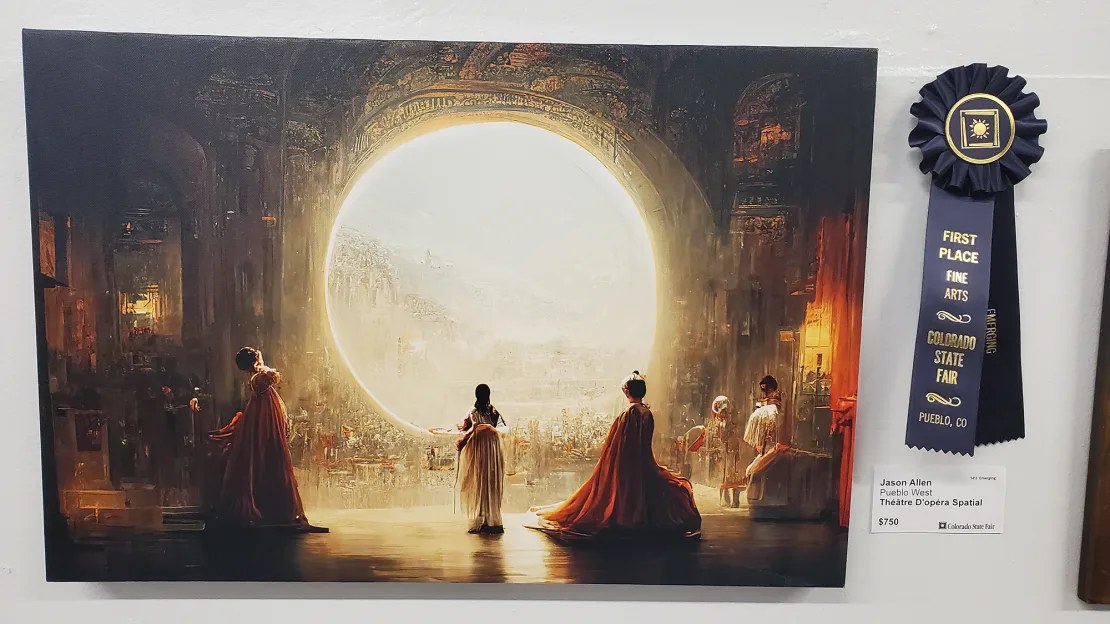
After Allen posted about his win, it soon went viral, albeit for the implications of what precedent this could mean. If an AI-generated artwork could win an art contest, what does this mean for the other artists who put in the hard work to draw and make their own art?
Many were furious at the idea of such, stating “AI artwork is the ‘banana taped to the wall’ of the digital world now.” They saw it as a mockery, or even the death of art, and as a quote of Allen himself, “Art is dead, dude. It's over. A.I. won. Humans lost.”
Absolutely not! Art is not dead! Fuck you Allen. Actually… I take that back. As while yes, this was generated by AI, Allen still had to put in the work to make sure that the image he submitted was quality.
He had to go through several prompts, around 900 or so to get the final three images he needed. Then, out of the three that he picked, one of the figures in the image was headless. To fix this, he had to photoshop black hair in, and then retouch it to make sure it fit in with the background.
This shows that even then, there will still be a level of human intervention required for AI to work optimally. Sure, in the future, AI may be able to operate completely on its own, or what is known as AI sentience. But one thing to consider is that since there has to be some kind of human input; what if we made sure that human input was less to make the entire piece in of themselves, but to help in making it?
For example, for programmers, there are coding assistants, such as GitHub Copilot, which help programmers be more efficient when writing code by predicting the next line that needs to be written. I've used it myself, and it is pretty damn cool and very helpful… but also a bit terrifying. It's kind of ridiculous that programmers have made AI that can also program; practically outsourcing themselves. Great work, guys. And so, as you can see, there's definitely the possibility that AI can be used as a tool to improve the workflow of professionals, not replace them. As said before, a tool can be used to make tasks more efficient, easier, and effective.
When I program, there are definitely times where it can get a bit tedious, such as constantly reformatting the code to make sure it not only looks nice, but runs properly, writing comments and documentation for other programmers to understand the code, etc, etc. AI can and has helped me do this, and I've become a lot more efficient as a result. We can expand this to a plethora of different fields, which will not only make our work more efficient, but also help us become better in our fields.
You're still doing the work, it's just less tedious now.
The future of AI
AI regulation is already happening. In April 2021, the European Parliament proposed a framework based on different levels of risk and different rules for different uses. That is a sensible starting point, but writing rules is easier than enforcing them across systems that change every few months.
Regulating AI has the same problem as regulating the Internet: the technology is distributed, the uses are hard to predict, and a rule that fits one system may miss the next one. Regulation can still set useful limits around privacy, safety, and accountability. It just cannot do the whole job by itself.
A leaked Google developer memo, titled “We Have No Moat, And Neither Does OpenAI”, argued that open-source systems were narrowing the advantage held by large companies. Whether or not the memo's predictions hold up, it points to a real tension: AI will not stay inside a few companies forever, which makes public rules and public understanding more important.
Open-source work can make AI more accessible, but access does not automatically make a system safer. The people building and using these tools still need to explain what they do, what they cannot do, and who carries the risk when they fail.
On one hand, AI offers solutions to some of the most pressing challenges humanity faces. Imagine a future where we could model the DNA of our bodies, creating perfect humans immune to disease and given superpowers, or hell, even space travel.
In GTC 2024, NVIDIA's annual AI conference, Jensen Huang, the co-founder of NVIDIA, which is responsible for powering most AI nowadays thanks to their innovations in computer hardware, introduced their new Blackwell architecture. This new architecture could bring supercomputers powerful enough to compute the requirements that AI needs. This may be what we just need to break the boundaries of AI. This could mean a myriad of different possibilities, with much more powerful and better AI, but will require much more people to not only create, but regulate, and democratize AI.
I won't lie that AI is quite terrifying. It could definitely be the death of us all, replacing us and doing all of our work, or worst-case scenario, they gain sentience and enslave us or something like that. But AI can also be our key to the future. It has and will continue to impress us with just how much it can do as we further innovate. It should be a tool for all of us to use.
So, I ask you this: (Don't) be afraid of AI. In fact, if you already weren't, try to experiment what you can do with AI and how you could improve what you do currently. If you're scared of AI replacing you, it'll be less that AI will replace you, but more that somebody else who uses AI will.
(Don't) be afraid of AI. (Don't) be afraid of the future.